Small Room, Big Personality: Five Vintage Chairs That Earn Their Corner
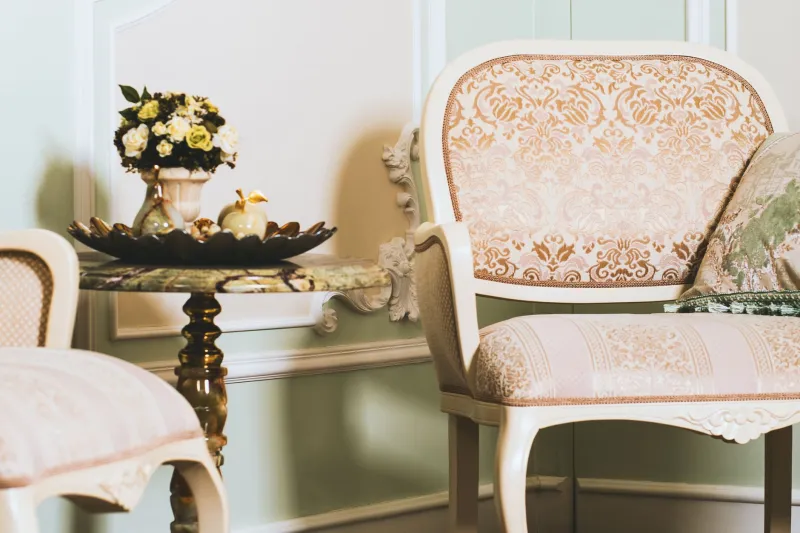
Small sitting rooms are the great British speciality. The front room of a Victorian terrace, the lounge of a 1930s semi with a bay window eating a third of the floor, the one-bed flat where the sofa and the telly are in a permanent standoff. Filling rooms like these with vintage furniture isn't about cramming in the biggest, oldest thing you can find — it's about choosing pieces that are generous in character and modest in footprint.
Here are five chair types that do exactly that, plus notes on what they're like to actually sit in and where you might find one in 2026.
Measure first, swoon second
Before anything else, get the tape measure out. Note the width of your doorway (many period internal doors are around 762mm, though bathroom and cupboard doors are narrower), the depth of the gap between sofa and wall, and how much floor you need free to walk through without turning sideways. A chair with a 70cm-wide seat and a 75cm-deep frame will sit politely in most small rooms; anything past 85cm deep starts to feel like a bollard.
Then decide where it will live. A chair tucked into a chimney breast alcove, angled into a bay or set beside a bookcase reads as furniture. The same chair floating in the middle of the floor reads as an obstacle.
1. The bedroom chair that never stays in the bedroom
Edwardian and Victorian bedroom chairs — narrow, upright, often with a low padded seat and a turned leg — are the quiet heroes of small sitting rooms. They're typically 45–50cm wide, so they slip into gaps that would refuse a proper armchair, and the upright back makes them surprisingly good for reading or perching with a cup of tea.
The catch is comfort. Original upholstery is often horsehair and hessian, which has roughly the give of a paving slab. A fresh seat pad in a soft pastel linen — shell pink, pale butter, eau de nil — transforms them for very little money, and a small bolster at the base of the back does the rest.
Where to find them: they turn up constantly in charity furniture shops, often for £15–£45. British Heart Foundation furniture stores, Sue Ryder and Emmaus shops reward a Saturday circuit. Local auction salerooms sell them in pairs for £20–£60, and house clearance lots often include two or three.
2. The tub chair
A tub chair is the most space-efficient route to a proper armchair. Because the arms curve round into the back, there's no wasted external frame, and a 1930s–1950s example usually measures around 70cm wide by 70cm deep — no bigger than plenty of modern accent chairs, but with a shape that genuinely holds you.
Look for one with a sprung seat rather than a solid board, and check the base: webbing perishes and foam turns to dust. Neither is a disaster. Re-webbing a tub chair is a satisfying weekend job, and reupholstering in washed linen or a soft wool bouclé is where the pastel palette earns its keep. Sage green and dusty blue are forgiving of everyday life; cream is beautiful and brave.
Where to find them: mid-century tub chairs appear regularly at regional auction houses and on Facebook Marketplace around £40–£150 in need of work, or £250–£450 restored from a dealer. A reupholstered tub chair beats a threadbare original every time.
3. A stick-back Ercol or Windsor lath chair
If your room is small in floor area but tall, a light-looking chair is a gift. Ercol's stick-back designs, and the wider family of Windsor lath-back chairs, are visually airy: you can see through them, so they don't wall off a corner the way a solid back does.
They're not lounging chairs. They're for pulling up to a small table, for a corner with a cushion, for the guest who needs somewhere to sit that isn't the floor. The pale elm and beech take a soft paint beautifully — a washed-off coat of pale putty or duck-egg on the frame, with the seat left natural, is a lovely halfway house.
Where to find them: Ercol is well served by specialists, but the bargains are at general auction and in the classifieds. Expect £30–£90 for a single painted stick-back, more for a labelled original in good order.
4. Lloyd Loom
Woven loom chairs — the classic British bedroom and conservatory seat — are sturdier than they look and almost absurdly light to move. A loom tub or bedroom chair is usually under 60cm wide, and the woven body means you can shift it one-handed when the room needs to become a dining space.
Check the weave for splits and the frame for rust, especially on anything that has lived in a conservatory. A sound one can be repainted with a spray can in half an afternoon; shell pink, mint and pale lemon all suit the texture.
Where to find them: car boots, charity shops and local auction, typically £20–£80. Restored and repainted examples from dealers run £150–£300.
5. The slipper chair
Armless, low-backed and wonderfully compact, the slipper chair was designed to be easy to move and easy to tuck away — qualities that translate perfectly to a small sitting room. It's the chair that goes under a window or into the gap beside a fireplace without a fight.
Original 1950s and 1960s slipper chairs turn up with splayed legs and sprung seats. They're excellent candidates for a statement fabric because there's so little of it: a metre and a half will usually cover the seat and back.
Where to find them: mid-century dealers, eBay and local auction. Budget £60–£120 unrestored, £200–£400 reupholstered.
A note on comfort and honesty
A pretty chair that nobody wants to sit in is a sculpture. Before you commit, sit in it for five minutes. Check the frame doesn't rock, the joints don't creak and the seat doesn't bottom out. Replacement foam is cheap; new joints are a job for someone with clamps and patience.
And measure the door. Every vintage chair buyer learns this once, in a doorway, in the rain.