Six Silvered Companions: Vintage Mirrors That Lift a Dim British Room
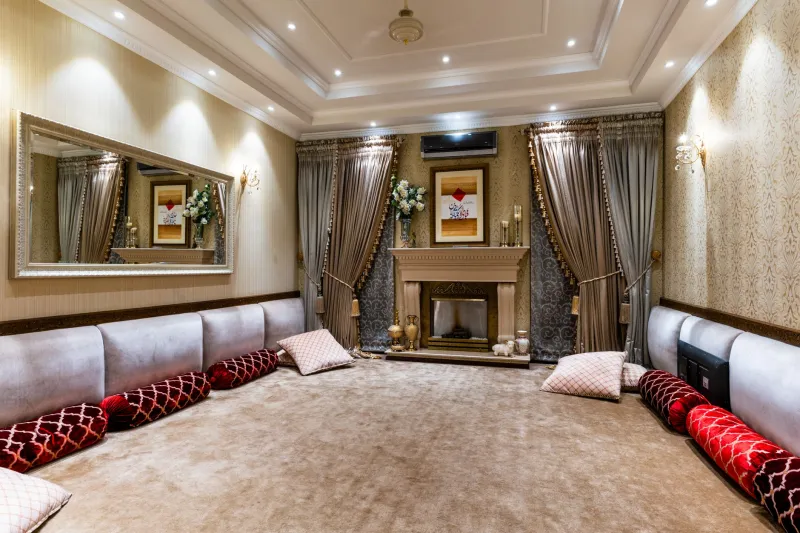
There's a particular sort of British room that never quite gets going. The one above the shop, the terraced front parlour with the window that faces the wrong way, the hallway where the coat rail has eaten all the light. You paint it a soft eau-de-nil, you add a lamp, you sit down with a cup of tea — and it still feels like four o'clock in February.
Nine times out of ten, the answer isn't a bigger bulb. It's a mirror. A good old one, slightly foxed, bought for the price of a takeaway, hung with a bit of thought. Vintage mirrors do two jobs at once: they move light about the place, and they bring a bit of history in with them. Nothing new from a warehouse does that nearly so well.
Why an old mirror beats a new one
Modern mirrors are often thin, bright and utterly without character — flat silver that shows you the back of your own head and nothing else. Old glass has a bit of body to it. It was made in slightly uneven sheets, silvered by hand, and after eighty or a hundred years it has developed a softness round the edges. Some of it has gone spotty. That's the bit people try to sand off or replace, and it's also the bit you should keep.
So: six styles to look out for on your rounds of the charity shops, the Friday auction, the local reclamation yard and the car boot that opens at seven and shuts at noon.
1. The giltwood cushion mirror
You'll know it by the frame — a fat, scalloped border built up in layers, usually with a little rosette or shell at each corner, gilding flaking off in a way that looks careless but was probably just time. They turn up in pairs from house clearances, and a pair is worth waiting for.
Hang one over a fireplace in a sitting room that faces north. The glass picks up whatever lamp or candle is nearest and throws it back into the room, and the gold warms everything without a single pastel being disturbed.
2. The chippy painted farmhouse mirror
Often a plain rectangle or a simple arched top, with a frame that was painted cream, then duck-egg, then cream again, and has since given up in places. This is the most forgiving mirror you can buy, because it will sit happily in a kitchen or a boot room where nobody is being careful.
Put one above a dresser or at the end of a narrow kitchen run. It won't make the room bigger in any measurable sense, but it will make the far wall feel twice as deep.
3. The Edwardian oval with a bevelled edge
Slender, quiet, usually with a rim of narrow moulding and a bevelled cut round the glass that catches light along its line. These are the bargain of the vintage mirror world — nobody fights over them, and they're everywhere.
Two of them, hung one above the other in a tight stairwell, are a lovely thing. Or one on its own in a small loo, which is where a mirror earns its keep fastest.
4. The faux-bamboo or bamboo-frame mirror
Bamboo frames were everywhere from about 1890 to 1935, and the good ones are turned wood stained to look knuckled and joint ed like the real thing. They bring a slightly raffish, conservatory-ish quality to a room — good against a pale pink or soft green wall, less good in a dark room, where the browns go muddy.
Lean one on a chest of drawers rather than hanging it. Leaning is the single easiest styling trick there is, and it lets you move the thing next week when you change your mind.
5. The 1930s peach or etched Deco mirror
Look for the geometric shapes — stepped corners, a fan, a chevron — and glass that often carries a faint etched pattern round the border. Many were made with a peach or rose-tinted backing, which throws a warm glow that is almost indecently flattering in a hallway.
This is the one to hang where you look at yourself on the way out of the door. The tint softens a bad morning better than any filter.
6. The little church-window arch
Pointed or round-topped, sometimes with leaded or frosted glass, usually small. They came out of vestries, schoolrooms, chapels and the backs of old shops. They're not much use for checking your hair, but as a decorative light-lifter in a narrow hall or at the top of a landing they're perfect, and they cost very little.
Where to hang it, honestly
A few rules that hold up in real houses:
- Opposite a window, not beside it. The whole point is to catch the light and send it back across the room. Beside the window does almost nothing.
- Below eye level in a hall. Slightly low is better than slightly high; it makes a narrow space feel taller above you.
- Above the fireplace is fine — the old superstition about mirrors over mantels is nonsense, and it's still the best-lit wall in most sitting rooms.
- Don't point it at the telly or at a blank wall. A mirror should reflect something worth looking at: a plant, a lamp, a bit of pastoral wallpaper, a view.
- In a north-facing room, put the mirror where it will catch whatever light does arrive and bounce it towards a pale ceiling. Pale ceilings are the cheapest light source in Britain.
Foxed glass, tired gilding, chipped paint
Now the restoration notes, which are shorter than you'd think, because the right answer is usually 'less'.
Foxed glass — those little dark freckles and cloudy patches where the silvering has gone — cannot be repaired, only replaced, and replacing it costs more than the mirror did. Don't. Foxing reads as age and age reads as charm. If it's very bad and you can't bear it, put the mirror somewhere it isn't lit directly from behind.
Tired gilding doesn't want to be redone in bright new gold leaf. It wants a soft brush, a barely damp cloth, and a tiny touch of gilt wax on the worst bald patches. Anything more and you'll have a frame that looks like a hotel.
Chipped painted frames are the easiest of the lot. Rub down the flaking bits with fine paper, wipe off the dust, and touch in with a chalk paint a shade paler than the original. One thin coat, wiped back while tacky, then a smear of clear wax. The point is not to hide the chips — the point is to stop them spreading.
Loose glass in a frame: a couple of small glazing sprigs, tapped in gently, and a backing board of stout card. Never overtighten at the corners; old frames crack before they bend.
A last word on buying
Take a torch to the car boot. Look at the back of the frame as carefully as the front — a replaced back board or bright new mirror clips usually mean the glass has been swapped, which isn't a disaster but should change the price. And if the mirror is heavy and the hanging fixings look like they came off a picture postcard, budget for new ones before you get the drill out.
Then take it home, lean it against the wall, and live with it for a week before you commit to a nail. Most of the time, the room will tell you where it wants to go.